Coworking
Coworking Goes Celebrity: Why Indian Flex Office Brands Are Rewriting the Marketing Playbook
Shyam Sundar Nagarajan / Reading Time : 6 mins / Created: 8 May 2026 · Updated: 11 May 2026

Something unprecedented is happening in India's coworking industry. For the first time globally, flex office operators are deploying celebrity brand ambassadors—a marketing strategy you'd expect from consumer brands like watches, athletic wear, or beverages, not B2B real estate products.
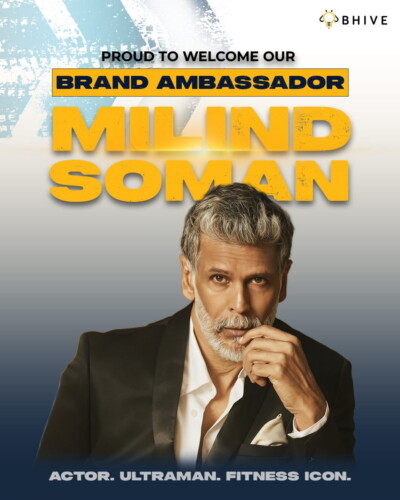
Ofis Square recently onboarded actress Yami Gautam as their brand ambassador. BHive brought in fitness icon Milind Soman. These aren't one-off influencer collaborations or event sponsorships. These are full-fledged, long-term brand ambassador partnerships—complete with outdoor campaigns, social media activations, and mass media visibility.
Scan the global coworking landscape, and you won't find a single parallel. WeWork's campaigns spotlight member success stories. IWG positions itself through corporate messaging. Industrious focuses on design and hospitality. None have hired a celebrity to be the face of their brand.
So why is India different? And what does this signal about where the coworking category is headed?
Key chapter:
From Niche to Necessity: The Category is Maturing
A decade ago, coworking in India meant scrappy startups hot-desking in repurposed bungalows. The market was tiny, fragmented, and largely invisible to the mainstream business world.
Today, India has over 500 flex office operators managing 2,600+ centres across 40+ cities. Global Capability Centres (GCCs) are taking entire floors. Traditional corporates are signing managed office leases. Demand has shifted from "Do we need this?" to "Which operator should we choose?"
When a category matures from niche to mainstream, brand differentiation becomes critical. In a market where every operator offers ergonomic chairs, high-speed WiFi, and "community," how do you stand out?
Celebrity brand ambassadors are a category maturation signal. They say: "Coworking isn't a fringe product anymore. It's something the common person should recognize and have an opinion about."
The goal isn't just to fill desks. It's to establish—in the minds of CEOs, facility managers, HR heads, landlords, and even retail investors—which brands are the category leaders.
Staking Territory: Positioning Within the Category
What's particularly strategic is how each brand has chosen their ambassador to reinforce a specific market position.
Ofis Square with Yami Gautam isn't a random celebrity play. Ofis Square is led by Anuradha Kedia, a woman entrepreneur building a premium brand in a male-dominated real estate sector. Yami Gautam—elegant, accomplished, known for her selective brand associations—mirrors that positioning. The subtext is clear: Ofis Square is premium, thoughtfully curated, and unafraid to challenge category norms.
BHive with Milind Soman is equally deliberate. BHive has been running marathons, sponsoring fitness events, and weaving workspace wellness into their brand narrative for years. Milind Soman—ultra-marathoner, fitness evangelist, the embodiment of disciplined healthy living—is the perfect extension of that story. BHive isn't just selling desks; it's selling a lifestyle where work and wellness coexist.
These aren't interchangeable choices. They're strategic anchors that help each brand carve out distinct territory in an increasingly crowded market.
The IPO Factor: Speaking to Retail Investors
There's another dimension at play—one that has less to do with customers and more to do with capital markets.
BHive, backed by Myntra founder Mukesh Bansal and flush with ₹300+ crores in funding, is widely expected to pursue an IPO in the next 18-24 months. Ofis Square, with its PE backing and rapid expansion, likely has a similar exit horizon.
Indian retail investors on Zerodha and Groww don't pore over EBITDA margins or lease liability footnotes. They invest in stories. They invest in brands they recognize. They invest in categories that feel like the future.
Celebrity brand ambassadors are investor relations at scale. When Milind Soman is on billboards across Bangalore talking about BHive, it's not just corporate decision-makers taking notice—it's the retail investor who'll subscribe to the IPO because they believe flex offices are "going mainstream, just like gyms did."
This is the Cult.fit playbook, remixed for coworking. Build brand salience through celebrity association, position the category as aspirational, then take it public when the narrative has taken hold.
From Real Estate Product to Lifestyle Brand?
Here's the bigger question all of this raises: Are we witnessing coworking's evolution from a real estate product into a consumer lifestyle brand?
Traditionally, commercial real estate is invisible. Tenants sign leases based on location, pricing, and square footage. Nobody talks about their office landlord at dinner parties. There's no brand loyalty, no emotional connection, no aspirational pull.
But coworking has always been different. From day one, it borrowed more from hospitality than real estate—think curated design, community events, branded coffee, member experience. The product was never just space; it was a promise about how work could feel.
Celebrity brand ambassadors take that promise mainstream. They make coworking something people have opinions about, even if they don't use it. They make it visible, aspirational, part of the cultural conversation.
In that sense, this shift mirrors what happened with gyms, co-living, and even electric vehicles in India. All started as functional products. All became lifestyle categories once celebrity endorsements, mass-market advertising, and aspirational positioning entered the frame.
The difference is that coworking still generates most of its revenue from B2B contracts, not individual consumers. The customer making the buying decision (the CFO, the office manager) might not care about Milind Soman. But the narrative around the brand—the sense that "this is where forward-thinking companies work"—absolutely influences the shortlist.
What This Means for the Industry
India's coworking operators hiring celebrity brand ambassadors is a market signal worth paying attention to.
It tells us the category has crossed the chasm. The pioneers who bootstrapped coworking into existence are being joined—and in some cases, displaced—by well-capitalized players with IPO ambitions and mass-market positioning strategies.
It tells us that brand, not just product or price, will determine who wins the next phase of this market. In a fragmented landscape of 500+ operators, a handful will establish themselves as household names. The rest will compete on availability and cost.
And it tells us that coworking in India is no longer just a real estate story. It's a consumer narrative, a lifestyle positioning, a bet on how work itself is being redefined for millions of professionals.
Whether this strategy pays off—whether celebrity endorsements actually drive enterprise contracts, landlord partnerships, and IPO valuations—remains to be seen.
But one thing is certain: Indian coworking operators are writing a playbook the global industry has never seen before.
And the rest of the world is watching.