Office Space
How the Bengal Elections Triggered a Real Estate Labour Crunch Across India
Shyam Sundar Nagarajan / Reading Time : 11 mins / Created: 16 June 2026
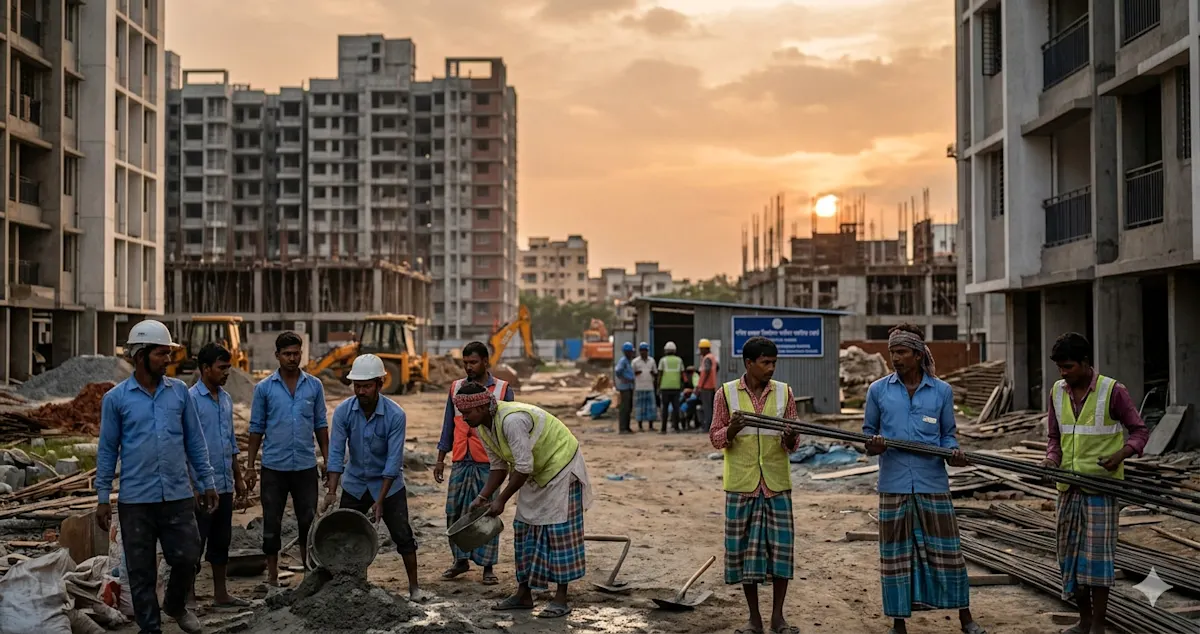
Table of Contents
- Quick Answer
- What exactly happened in 2026?
- What are the reported facts on the ground?
- Bengaluru and Chennai developers saw material workforce gaps
- Kerala’s construction sector faced an even sharper shock
- Developers are already paying more to pull labour back
- Why managed offices are especially vulnerable
- 1. Fit-outs are labour-dense
- 2. Timelines are tighter
- 3. The last mile is where delays become visible
- How residential projects are getting hit
- Slower execution across multiple stages
- Risk to handover schedules
- Rising labour costs
- Why this problem keeps resurfacing in Indian real estate
- Festivals
- Harvest seasons and local work cycles
- Elections
- Weather disruptions
- Crises like Covid
- Why workers are not returning as predictably as before
- Urban economics are less attractive
- Source states now offer more work than before
- Informal employment creates weak loyalty
- Social protection is still poor
- Why this is not just a construction story
- It delays new office supply readiness
- It changes occupancy decisions
- It puts a premium on ready inventory
- What the industry should do differently
- 1. Build labour planning into project strategy
- 2. Reduce overdependence on single-source labour pools
- 3. Formalize workforce systems
- 4. Accelerate mechanization and prefab where possible
- 5. Push for policy reform around migrant voting and portability
- The larger takeaway for real estate and workspace operators
- Final Thoughts
- FAQs
- Did the Bengal elections directly cause the real estate labour shortage in India?
- Why are managed offices affected by labour shortages?
- Which real estate segments are most affected?
- Why do these labour shortages keep happening?
- Can developers solve this only by paying more?
- What does this mean for companies looking for office space?
If you want the short answer, here it is: the Bengal elections did not create India’s real estate labour problem, but they exposed it again.
Over the last few weeks, developers across Bengaluru, Chennai and Kerala have reported severe labour shortages after migrant workers went back to West Bengal and Assam during the election cycle and did not return on schedule. Residential projects have slowed down. Fit-outs have been delayed. Managed office timelines have come under pressure. And once again, the industry has been reminded of a truth it often underestimates: Indian real estate runs on migrant labour.
This matters because real estate is usually discussed in terms of land, approvals, demand, financing and sales velocity. But execution on the ground still depends on a mobile, informal, contractor-led workforce. When that workforce leaves, projects slow. When it does not return quickly, handover timelines slip, costs rise, and the entire system feels the strain.
Let us start with the facts, and then get to the deeper question: why does this keep happening?
Key chapter:
- Quick Answer
- What Exactly Happened in 2026?
- What Are the Reported Facts on the Ground?
- Why Managed Offices Are Especially Vulnerable
- How Residential Projects Are Getting Hit
- Why This Problem Keeps Resurfacing in Indian Real Estate
- Why Workers Are Not Returning as Predictably as Before
- Why This Is Not Just a Construction Story
- What the Industry Should Do Differently
- The Larger Takeaway for Real Estate and Workspace Operators
- Final Thoughts
- FAQs
Quick Answer
The 2026 West Bengal Assembly elections triggered a large reverse migration of workers from construction sites in South India and other markets. Many workers travelled home to vote and stayed back longer than expected due to electoral roll verification concerns, holidays, travel bottlenecks, and better local opportunities. The result has been a labour shortage across residential construction, commercial developments and managed office fit-outs.
But the larger issue is structural. Indian real estate remains heavily dependent on migrant labour from a few source states. That means elections, festivals, harvest seasons and local disruptions can repeatedly create national project delays.
What exactly happened in 2026?
The West Bengal Assembly elections were held in late April 2026, with polling on April 23 and April 29 and results declared on May 4. Migrant workers routinely travel home during elections. What made this cycle different was the scale of the outflow and the slower-than-expected return.
A major trigger appears to have been anxiety around electoral roll verification and voter status. Reports suggest many workers feared that if they did not return to their home constituencies, their names could be removed from the rolls. For workers who are already part of a fragile, informal migration cycle, that fear was enough to prompt abrupt departures.
This was then compounded by:
holiday extensions around the same period,
costly and crowded travel,
limited rail availability,
delayed return planning,
and in some cases, access to local work closer to home.
So what looked like a temporary election break quickly turned into a broader workforce disruption.
What are the reported facts on the ground?
A few reported indicators show how serious the situation became.
Bengaluru and Chennai developers saw material workforce gaps
Industry reporting indicates that developers in Bengaluru and Chennai faced workforce declines of around 30% at some project sites. In at least one reported case, nearly 100 workers left during the election period, and a substantial share had still not returned weeks later. Many of these were skilled tradespeople, especially carpenters from West Bengal.
That detail matters. Labour shortages are not just about headcount. A shortage of specialist trades can delay entire phases of a project even if general labour is still available.
Kerala’s construction sector faced an even sharper shock
Kerala has been one of the clearest examples of dependence on migrant workers. Reports from April and May 2026 suggest that:
construction activity slowed sharply in multiple areas,
some developers and contractors described near-halt conditions,
one large infrastructure organization reportedly had only 500 out of 6,000 migrant workers available during the disruption,
and industry voices have said that construction in Kerala is overwhelmingly dependent on migrant labour.
Several studies and media reports also point to a high share of migrant workers in Kerala coming from West Bengal, Assam and Odisha, with West Bengal alone accounting for a very large portion.
Developers are already paying more to pull labour back
Some firms have reportedly begun paying for:
flight tickets,
bus transport,
advances,
and higher daily wages
to accelerate worker return and protect project schedules.
That tells you something important: this is not being treated as a small temporary inconvenience. It is already affecting economics.
Why managed offices are especially vulnerable
When people talk about real estate labour shortages, they usually think about large residential towers or civil construction. But managed offices and commercial interiors are often even more exposed.
Here is why.
1. Fit-outs are labour-dense
A managed office is not just a bare shell. It depends on:
partitions,
false ceilings,
flooring,
electricals,
HVAC coordination,
joinery,
furniture installation,
painting,
signage,
testing and snag closure.
These are labour-heavy stages. And they require specific trades, not just generic site manpower.
2. Timelines are tighter
Residential projects can sometimes absorb delay across longer development timelines. Managed office operators usually cannot. They often work against:
client move-in commitments,
leasing deadlines,
revenue start dates,
launch timelines for enterprise occupiers.
A 30 to 45 day delay in labour availability can directly translate into delayed occupancy and delayed billing.
3. The last mile is where delays become visible
In commercial real estate, the building may appear “mostly complete,” but the final 10–15% of fit-out work is what determines handover readiness. That final stretch is usually where labour shortages hurt the most.
This is one reason the current labour crunch matters beyond construction sites. It affects how quickly office inventory can actually become usable.
For businesses looking at flexible workspaces, this is also a reminder that ready-to-move-in managed offices and already operational workspace inventory become more valuable when new fit-outs are delayed.
How residential projects are getting hit
Residential construction is facing a different but equally serious problem.
Slower execution across multiple stages
Labour shortages affect:
rebar tying,
shuttering,
masonry,
plastering,
waterproofing,
electrical rough-ins,
plumbing,
tiling,
painting,
finishing and handover prep.
Construction is a sequence business. If one trade falls behind, every downstream activity gets pushed.
Risk to handover schedules
In a more tightly regulated market, delayed completion timelines come with legal, financial and reputational consequences. Developers already managing interest costs, approval risks and customer expectations now have to deal with uncertain workforce availability.
Rising labour costs
When contractors compete for a smaller labour pool, wages rise. Replacement crews are often more expensive and less productive. Travel support and retention bonuses add more pressure.
The result is a double hit:
slower productivity,
higher unit execution cost.
Why this problem keeps resurfacing in Indian real estate
This is the real story.
The Bengal elections triggered the current shortage. But the underlying weakness is much older.
Indian real estate remains deeply dependent on a labour model that is:
migrant-led,
seasonal,
informal,
subcontractor-controlled,
and highly sensitive to disruption.
That is why similar problems resurface during:
Festivals
Workers leave for Diwali, Chhath, Eid, Durga Puja and other regional festivals. Post-festival return has become slower than it used to be.
Harvest seasons and local work cycles
Many migrant workers are not permanently urban workers. They move in circular patterns between city jobs and home-state opportunities.
Elections
Large elections in source states create synchronized labour withdrawals across multiple destination markets.
Weather disruptions
Floods, monsoons and transport interruptions can reduce labour mobility and keep workers from returning on time.
Crises like Covid
The pandemic was the biggest reminder that the industry’s labour architecture is fragile. Several sectors, including construction and real estate, have still not fully normalized to pre-Covid labour behaviour.
So the issue is not just that workers leave. The issue is that the industry has built its execution model assuming they will always come back fast enough.
Why workers are not returning as predictably as before
Developers often frame this as a labour shortage. Workers may frame it differently.
A few reasons likely explain the slower return trend:
Urban economics are less attractive
The cost of living in major cities has gone up. Rent, food, transport and daily expenses reduce the benefit of migrating unless wages rise enough to compensate.
Source states now offer more work than before
As infrastructure and construction pick up in eastern and central India, some workers can find opportunities closer to home. That reduces dependence on long-distance migration.
Informal employment creates weak loyalty
Many workers are hired through subcontractors or labour intermediaries. When the relationship is informal, retention is weak. Workers move where the combination of wages, convenience and family obligations makes sense.
Social protection is still poor
The broader migrant labour ecosystem still struggles with:
poor housing,
limited healthcare access,
weak portability of benefits,
little formal retention support,
and limited institutional planning around worker mobility.
In other words, the industry depends on migrant labour, but often does not structure itself around migrant worker stability.
Why this is not just a construction story
This issue affects the entire office market in ways that are easy to miss.
It delays new office supply readiness
Even when commercial buildings are completed, tenant-ready interiors can lag.
It changes occupancy decisions
Companies with urgent move-in timelines may prefer operational managed offices over custom-built spaces that require fresh fit-outs.
It puts a premium on ready inventory
In markets facing fit-out uncertainty, platforms that help companies compare and move into ready workspaces become more useful.
This is not a sales point. It is simply how markets behave under execution stress.
When labour shortages slow down construction and fit-outs, flexibility becomes more valuable.
What the industry should do differently
If this is a recurring problem, then reactive firefighting is not enough.
1. Build labour planning into project strategy
Developers already plan for approvals, procurement and financing. Labour continuity should be treated with the same seriousness.
That means:
mapping workforce concentration by source state,
anticipating election and festival calendars,
building buffer capacity for key trades,
and planning transport and return logistics in advance.
2. Reduce overdependence on single-source labour pools
Projects become more fragile when one geography supplies a disproportionate share of key workers.
3. Formalize workforce systems
More direct payroll structures, better accommodation, digital records and stronger worker retention models can improve continuity.
4. Accelerate mechanization and prefab where possible
Not every activity can be mechanized, but reducing manual dependence in repetitive construction processes can improve resilience.
5. Push for policy reform around migrant voting and portability
If migrant workers must choose between democratic participation and uninterrupted employment, the system will keep producing these shocks. Remote or portable voting mechanisms deserve serious policy attention.
The larger takeaway for real estate and workspace operators
The direct lesson from the Bengal election labour crunch is simple: real estate is not only capital-intensive. It is labour-contingent.
And that matters a lot for:
developers,
managed office operators,
enterprise occupiers,
project management consultants,
and anyone depending on predictable handover timelines.
The deeper lesson is even more important. The industry does not have a labour problem only when elections happen. It has a labour fragility problem all the time. Elections just make it visible.
Final Thoughts
The 2026 Bengal elections have exposed a recurring truth about India’s real estate sector: buildings may be funded by capital and sold through demand, but they are still delivered by people.
And those people are often migrant workers moving across states through informal labour networks that remain vulnerable to politics, seasonality, cost pressures and weak protections.
That is why this issue keeps returning. Not because the industry is unlucky, but because the structure itself is fragile.
For the managed offices segment, the takeaway is especially relevant. In a market where speed, certainty and readiness matter, labour disruptions can reshape what clients value. Ready inventory, flexible occupancy models and execution certainty become strategic advantages.
The industry should not wait for the next election cycle, festival season or mobility shock to remember this again.
FAQs
Did the Bengal elections directly cause the real estate labour shortage in India?
They were the immediate trigger in 2026, especially because many workers from West Bengal and nearby states returned home during the election cycle and delayed coming back. But the deeper issue is the industry’s ongoing dependence on migrant labour.
Why are managed offices affected by labour shortages?
Managed offices rely heavily on fit-out work such as electricals, ceilings, partitions, flooring, painting and furniture installation. These are labour-intensive finishing activities with tight delivery timelines.
Which real estate segments are most affected?
Residential construction, commercial projects, interiors, managed offices and fit-outs are all affected. The last-mile finishing stages are often the most vulnerable.
Why do these labour shortages keep happening?
Because the real estate sector depends on circular migrant labour. Elections, festivals, harvest seasons, weather disruptions and crises like Covid can all interrupt labour availability.
Can developers solve this only by paying more?
Higher wages and travel support may help in the short term, but they do not fix the structural issue. The sector also needs better planning, formalization, diversified labour sourcing and more resilient execution systems.
What does this mean for companies looking for office space?
It means timelines for newly fitted-out offices may become less predictable during labour disruptions. In such conditions, ready-to-move-in managed offices and operational flexible workspace options become more attractive.